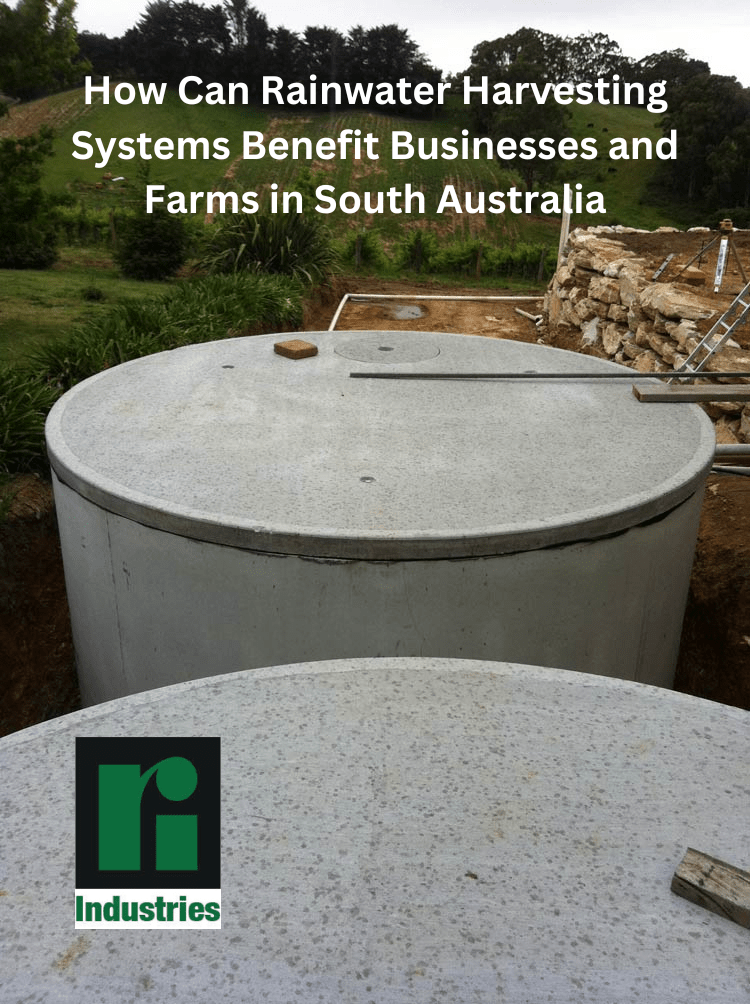
Concrete Rainwater Tanks – What are the Benefits?

by Ri Industries

Get your rainwater tank in time for the ‘rainy season’ in South Australia. We get most of our
rainfall during the winter months of June, July and August, so now is a great time to get
prepared. Let’s look at some of the benefits of using a Ri-Industries concrete rainwater tank.
Rainwater harvesting is a technique used for collecting, storing and using rainwater for
landscape irrigation and other uses. It’s popular in South Australia due to its numerous benefits
such as:

● Reduces water bills
● Provides an alternative water supply during water restrictions
● Helps maintain a green and healthy garden
● Depending upon the tank size and climate, rainwater harvesting can reduce mains water
use by 100%
● Decreases storm water runoff, thereby helping to reduce local flooding.
● Rainwater causes less erosion to household appliances due to their low salinity content
● Rainwater is softer than mains water which may mean you use less soap, detergent, and
shampoo.

What are the benefits of our concrete rainwater tank? Concrete rainwater tanks offer a number
of advantages:

● The water stays cooler.
● No algae develops.
● The water has no after-taste.
● They are vandal-proof and fire-proof.
● Being underground means they are out of sight and don’t take up much of your valuable
real estate.
● Concrete is stronger and more durable.

How much water can be saved using our concrete rainwater tanks? A family of four with a
100m² roof catchment area and a 1000L tank can capture enough rainwater in one year to:

● Flush a toilet 2X/day per person
● Fill a 150L tub to provide a bath for one person per week

● Run a sprinkler system for one hour 5X/week
● Use dishwasher every day
● Give a 5 minute shower to each person 2X/week

Good for the environment + saves money = a great investment! Call us at 08 8444 8100 to
speak with one of our experts and learn about installing a concrete rainwater collection tank at your home.

Rainwater Tanks for Homes in South Australia

by Ri Industries

Rainwater tanks are the most common way to meet the additional water supply requirements that South Australian building rules need for new dwellings and some extensions or alterations. So, what should you look for in a rainwater tank and what can the collected water be used for? Ri-Industries has the answers.

What to look for in a rainwater tank:

  • Covers are essential to help avoid children and/or animals from getting inside the tank. They also help reduce water evaporation and deters algae growth which can result when sunlight enters. 
  • Underground or Above ground? The choice is yours! Above ground tanks can be easier to install because you don’t have to excavate a space for them first. However, they can take up valuable room. Underground rainwater tanks can save a lot space and can be installed in smaller properties where the size of the property would otherwise prohibit the use of a tank. They are often installed underneath driveways and are a popular choice for new home developments.
  • Where will it go? Ri-Industries are experts in underground rainwater tanks and our experts can help you determine the ideal location to install your underground rainwater tank. 
  • Rainwater tanks definitely fall into the category of something you want to last. Our concrete tanks are designed and built to do just that. They also come with a  manufacturers warranty to give additional piece of mind. 

How to use the water collected in rainwater tanks:

  • Hot water systems
  • Laundry
  • Toilets
  • Irrigation

One of the most frequently asked questions we hear is whether or not it’s safe to drink water from the rainwater tank. The answer is no, unless a filtration system is added to first purify the water. The collected water may contain emissions from vehicles/industry and the cleanliness (or lack thereof) of the gutters it flows through also play a factor. 

When you are interested in learning more about rainwater tanks or are ready to purchase, please give Ri-Industries a call on 08 8444 8100.

Why Rainwater Tanks are Popular and Important in South Australia

by Ri Industries

Rainwater tanks are popular and important in South Australia because they help us conserve water. Let’s look at how they are used and how much water they can save.

In South Australia, rainwater tanks are used in communities without access to reticulated water sources, in communities where good quality water supplies are limited, in areas where local regulations require rainwater storage be provided for bushfire prevention, and in urban areas, such as Adelaide and regional communities, which have access to mains water but owners want to conserve water. 

Some advantages of rainwater tanks include:

  • The use of rainwater costs less than mains water
  • Rainwater causes less erosion to household appliances due to their low salinity content
  • Protects water supplies by conserving mains use
  • Rainwater is softer than mains water which may mean you use less soap, detergent, and shampoo

To read more about the benefits of rainwater tanks, please see our blog, What are the Benefits of Rainwater Harvesting.

One of the main benefits of rainwater harvesting is the ability to conserve to water. So, how much can you save? Put into everyday terms, a family of four in Adelaide, with a 100m² roof catchment area and a 1000L tank can capture enough rainwater in one year to:

  • Flush a toilet twice per day per person

OR

  • Provide one bath per person per week (150L tub)

OR

  • Run a sprinkler system for one hour five days a week (1.5 L/min)

OR

  • Wash dishes in the dishwasher every day

OR

  • Give each person a 5 minute shower twice a week (standard flow shower)

If we’ve piqued your interest in rainwater harvesting and you would like to learn about our rainwater tanks, please see information on our website or call us at 8444 8100.


Rainwater Harvesting Benefits Farming and Agriculture

by Ri Industries

Farming and agriculture play an important role in Australia. Rainwater tanks contribute to their success by reducing their reliance on mother nature.

Farms require an abundance of water to keep their crops and livestock healthy. In Australia, which is known for its dry climate, rainwater tanks Adelaide can help keep the water flowing despite a lack of rain. Another concern of farmers is the outbreak of disease or parasites. When this occurs, it’s in their best interest to have access to their own clean water supply.

Farmers use rainwater harvesting, which is the primary and most efficient component of water supply management for rural and regional Australia, to fill the rainwater tanks. Rainwater that falls on the roofs of houses, sheds, and other farm buildings is collected and stored in tanks. This is an easy way to locally collect water and use it where and when it’s needed.

The collected water can be used in various applications such as feeding stock, spraying crops, and storing water for firefighting. The quality of rainwater is typically superior to water from sources such as dams and local waterways which means it can also be used for domestic use.

Rainwater harvesting is expected to become more popular in the years to come. This is in part due to the cost-effectiveness of rainwater harvesting as compared to setting up main water and sewage services in semi-rural and rural areas. In fact, rainwater harvesting is so cost-efficient that arguments have been made that it should be used more widely in urban areas as well.

The bottom line is that safely storing water in tanks is a cost-effective way to see you through many types of water crises, including drought. If you’d like to learn more about rainwater harvesting and/or Ri-Industries rainwater tanks, we have a range of articles you can read available on our website. Of course, we’ll be happy to take your call to answer questions as well. You can reach us at 08 8444 8100.

How to Prevent Mosquitoes From Breeding in Rain Water Tanks

by Ri Industries

You may think of mosquitoes simply as a nuisance that come with warmer weather, but they can actually be much more than a nuisance – they can be a health risk. Mosquitoes can transmit serious diseases such as malaria, Zika virus, dengue fever and more. They breed in standing water which means your gutters, pipes, and rainwater tanks Adelaide are ideal environments for them. But don’t worry, there are some simple solutions to help keep the mosquitoes at bay and reduce the health risk to you and your family. 


  • ‘Over the gutter mesh’ can be fitted to the gutters to keep leaves and debris from gathering and pooling water. The holes in the mesh should match the size of the leaves in the area. If gutter mesh is not an option, keep trees well trimmed and clean the gutters on a regular basis.
  • Place mosquito-proof screens where the pipe that carries water to the rainwater tank meets the gutter. This will help keep leaves and debris from piling up causing stagnant water.
  • Where the pipe meets the tank, install a mosquito-proof, self-closing flap valve.
  • Use mosquito-proof mesh on the inlets and overflow on the tank. Sealing the overflow can reduce the incidence of mosquitoes by two-thirds—even if the inlet is poorly sealed.
  • Check and clean the first flush device of your rainwater collection system every three months
  • Regularly inspect the mesh to ensure it is in good condition and if it’s not, replace it.
  • Divert overflow water to a covered drain. When the overflow drains to a grassy area, the water can pool and become a breeding ground for mosquitoes. 


Taking the above precautions should help to reduce mosquitoes, but what happens if they do manage to get into your tank? 


You will know that mosquitoes have been breeding if you see larvae wriggling on the surface of the collected water. First, remove and discard the larvae. Then, find where the mosquitoes entered your system and fix the issue. Inspect the tank, mesh, pipe, and gutters. 


Ri-Industries concrete rainwater tanks are made from high frequency vibrated reinforced concrete using the highest quality of materials. Steel mesh is cast into the rainwater tanks and lids, and all fittings are made from brass – to give additional peace of mind. Please call our office, 8444 8100, to learn more about our rainwater tanks, delivery, and installation.

How to Create a Rainwater Harvesting System

by Ri Industries

Congratulations! You’ve done the research and have decided that collecting rainwater is a good decision for your household. Now you need to learn what steps need to be taken in order to begin collecting rainwater.

First,  you must decide which type of storage tank you will use. The experts at Ri-Industries recommend our concrete underground rainwater tanks which offer the following benefits:

  • The water stays cooler.
  • No algae develops.
  • The water has no after-taste.
  • They are vandal-proof and fire-proof.
  • Concrete is stronger and more durable.
  • Being underground means they are out of sight and don’t take up much of your valuable real estate.

Once you’ve decided which type of storage tank you will install, it’s time to think about how you will actually collect the water. House, garage and shed roofs are generally used as catchment areas. 

To keep the rainwater clean, it is important to attach leaf screens to gutters, prevent vegetation from overhanging the roof, and thoroughly clean the roof and gutters before installing. Avoid collecting rainwater from sections of the roof that contain lead flashing or asbestos sheeting, as well as from roofs painted with pre-1980 paint. 

Some extra steps should be taken when using the collected rainwater as drinking water. The Plumbing Code of Australia requires that a testable backflow prevention device is fitted on any mains water supply to the house and tested annually. First flush diverters are recommended for all drinking water systems and are beneficial for systems supplying other internal uses. For garden irrigation supply, their main benefit will be to reduce the need for desludging the tank. Since dust, debris, and bird droppings accumulate on the roof during dry spells, the first rain will wash them off the roof and into your rainwater tank. First flush diverters are designed to prevent the unwanted substances from entering the tank. 

Now that the rainwater has been collected and stored in the tank, you will need a system to bring the water into the house or out to the garden. You have a couple of options to use with the Ri-Industries concrete water tanks. 

A header tank is a great choice for use with an underground tank. It is placed at a higher level than the storage tank. A low-powered pump will transfer the water from the rainwater tank to the header tank, then the water is released using gravity.

A pressure pump is another option which will deliver water at, or near, mains pressure.  You will need to decide between a submersible or free-standing pump and will also need to install a pump controller. 

Collecting rainwater is a fantastic way to save money and resources. The experts at Ri-Industries can help you choose the system that is best for your home. Please call us at 08 8444 8100 with all your questions.

How to Water Your Garden With Water Collected in a Rainwater Tank

by Ri Industries

Before we discuss how to water your garden with water collected in a rainwater tank, let’s discuss why you might want to use rainwater.

First, rainwater harvesting reduces pollution. When rain falls, oil, pesticides, animal waste and fertilisers from lawns, footpaths, driveways, and streets get washed into our sewers which then overflow into rivers and estuaries. By harvesting rainwater, we eliminate those possible contaminants joining the water. Harvested rainwater is also free of salts, pollutants, and chlorine that are found in ground and surface water.

Second, harvested rainwater reduces demand on our water supplies. This is especially important during the summer months and times of drought.

Now that you have decided to harvest rainwater, how do you actually capture the water? We recommend installing a Ri-Industries Concrete Rainwater Tank. Our underground concrete rainwater tanks offer a number of advantages:

  • The water stays cooler.
  • No algae develops.
  • The water has no after-taste.
  • They are vandal-proof and fire-proof.
  • Being underground means they are out of sight and don’t take up much of your valuable real estate.
  • Concrete is stronger and more durable than plastic, steel or fibre glass.
  • Once the rainwater tank has been installed, you will need to move water from the tank to your garden. The best way to do this is with a pump.
  • Pump systems can be submerged underground or they can be free standing. They can provide enough pressure that the water flows similarly to mains water. You can also install a mains switch-over device to switch from rainwater to mains use when the rainwater runs out.

Another option to consider is having a header tank. This is a great option to use with underground tanks. The header tank will be placed at a higher level than the storage tank. A low-powered pump will transfer the water from the rainwater tank to the header tank, then you can use a gravity fed method to release the water. You can fit a garden tap near to the bottom of the header tank and use a soaker hose to transfer the water out of the tank, using gravity.

Watering your garden with harvested water is a great way to help conserve water and eliminate pollutants. Ri-Industries is proud to provide quality concrete rainwater tanks in Adelaide and surrounding areas for your use. Please call us to speak with one of our experts to learn more.

Times Are Dry

by Ri Industries

Adelaide just recorded its driest January since 1957 and water has been in short demand. This seems like a good time to discuss how you can save water in your home. Let’s look at water use in the bathroom and kitchen.

Did you know 40% of all water used in the home is used in the bathroom? To help conserve water and save money, the first thing to do is look at the appliances and look for products with a high star rating. The average home can save approximately $150/year by installing a standard 3-star rated shower head which costs approximately $20.

Some simple habit changes can also help save water in the bathroom:

  • Take shorter showers.
  • Use a timer in the shower to help you keep track of time.
  • Use a bucket to collect water while waiting for the water to get hot. Use the collected water on plants or other household uses.
  • Insulate hot water pipes.
  • Do not run water while shaving. Use water only to rinse off.
  • Only use as much water as is necessary in the bath.
  • Monitor the temperature as the bath fills to avoid adding water to regulate the temperature.
  • Collect used bathwater to use in the garden or to wash cars.
  • Use 4-star rated toilets.
  • Regularly check toilets for leaks and repair when needed.
  • Turn the water in the sink off when brushing teeth or shaving. Use running water only to rinse.

Another method to conserve water is to install a rainwater tank such as the one manufactured by Ri-Industries. Once the rain starts coming again, it can be collected from your roof and gutters. The rainwater tanks Adelaide can be connected to your toilet plumbing. Then, every time you flush, you are using rainwater, instead of water from the mains. Recycled rainwater is an excellent way to conserve water, plus it will save on your monthly water bills.

Let’s move to the kitchen where around 10% of total household water is consumed. Here are tips to help save water:

  • Dishwashers consume the most water in the kitchen. Look for the WELS label of water efficiency. The more stars, the more water efficient the appliance. Only run the dishwasher when it is full. If the dishwasher has a rinse-hold setting, use it in lieu of rinsing dishes with sink water.
  • Do not run water over frozen food to defrost. Instead, defrost overnight in the refrigerator.
  • Use washing-up liquid sparingly to limit the amount of rinsing required.
  • Waiting for the running water to warm up? Catch it in a container and use it to water plants, rinse dishes, or wash fruits and vegetables.
  • Use a plugged sink or a bowl of water whenever possible to avoid running the tap.

Small changes can mean big savings in water consumption. In dry times like these, it’s important for us all to make an effort. Call Ri-Industries, at 08 8444 8100, to learn more about our concrete rainwater tanks.

Why Use Pre-Cast Concrete?

by Ri Industries

Ri-Industries has been specialists in pre-cast concrete products since 1947. We think that’s impressive! We’re hoping you will think that too, especially once you fully understand what pre-cast concrete is.

Regular concrete, or insitu or site-cast concrete, is poured on site. In contrast, high quality precast concrete is produced in a controlled factory environment using advanced manufacturing techniques. Reusable, reinforceable, and adjustable moulds are used and they are set up per design specifications before the concrete is poured in. Then the concrete is poured, vibrated, and cured. If specified, architectural finishes (such as honing, polishing or staining) may then be applied while still in the factory. From there, the finished pre-cast elements are transported to the site and craned into position.

By manufacturing the concrete in a factory, we are able to do all the pre-checks before products get delivered to site which gives us increased quality control over insitu concrete. Dimensional accuracy, properties of the hardened concrete and position of reinforcement can all be checked before being sent to site.

Pre-cast concrete is extremely versatile. For example, we use it to make septic tanks, waste water treatment systems and rainwater tanks. It’s also safe for indoor use since it doesn’t require any chemical treatment.  We also work regularly with civil engineering and construction companies to provide tailored pre-cast concrete solutions, such as bridge parapets, arch tunnels and retaining wall panels.

One of the great benefits of pre-cast concrete comes at the construction site. Unlike insitu concrete, there are no worries about weather delays. We can avoid a lot of headaches and hassles with this one. Because the tank is already formed in our factory, we can crane it into position during a rainy day just as we can on a sunny day (providing the rain hasn’t caused any access problems for our trucks). By manufacturing pre-cast concrete products in a factory, this also means that you can get the same results each time, as the weather will often affect the outcomes of concrete being poured on site.

On site, precast can be installed immediately, there is no waiting for it to gain strength and the modularity of precast products makes installation go quickly. With the ability to so tightly control the process, from materials to consolidation to curing, you can get extremely durable concrete.

These are just some of the reasons we are proud to be pre-cast concrete specialists.   What projects can we complete for you? You can see some of our work on our website , but better yet, give us a call at 08 8444 8100.


Rainwater Harvesting FAQ’s

by Ri Industries

What is rainwater harvesting? Why should I harvest rainwater? We get asked lots of questions about our concrete rainwater tanks, and collecting rainwater.  So, we have compiled a list of frequently asked questions along with the answers to help spread awareness.

  1. What is rainwater harvesting?  Rainwater harvesting is a technique used for collecting, storing and using rainwater for landscape irrigation and other uses.
  2. From where is rainwater collected? The rainwater is collected from various hard surfaces such as rooftops and/or other manmade aboveground hard surfaces.
  3. Is rainwater harvesting only for rural areas? No, it is not just for rural areas. Although urban households may be connected to a reticulated, treated (mains) water supply, rainwater harvesting can significantly lower mains water usage.
  4.  What are the benefits of rainwater harvesting? It will reduce water bills, provide an alternative supply during water restrictions and help maintain a green, healthy garden. Rainwater harvesting can reduce mains water use by a substantial amount. Rainwater harvesting also decreases stormwater runoff, thereby helping to reduce local flooding and scouring of creeks.
  5.  Will harvesting rainwater be more costly? No, after all, rainwater is FREE! Once you have a rainwater tank installed, and start using this water instead of mains water, you begin saving money on your water bill each and every month.
  6. What can harvested rainwater be used for? Rainwater can be used to flush toilets, do laundry, water the garden, wash cars, and more.
  7.  Can I drink harvested rainwater?  If your rainwater is to be used for human consumption, the system must be designed, operated and maintained to ensure the water quality is suitable.

Ri Industries offers concrete rainwater tanks that can be installed below the ground. Being underground means they don’t take up much of your valuable real estate.

Have your questions been answered here? If not, call us at 08 8444 8100 and we’ll happy to answer all of your questions.


Using Concrete Tanks for Underground Storage and Bunkers

by Ri Industries

When you think of Ri-Industries, do you think of storage? Do you think of bunkers? Probably not, but you could. You may already be familiar with our reputation in precast concrete tanks used for waste water treatment systems, septic systems, and rainwater tanks. Now you can get to know us for some other uses.

We wrote about some of the unique uses for our tanks a while ago. If you read that blog, you will see pictures of concrete tanks being used as a base of a sculpture and even as a plunge pool. It also talks about using the concrete tanks for shelter and storage. We thought now might be a good time to elaborate on these, as we are seeing an increasing trend amongst our South Australian customers for underground cellars and bunkers.

The political and environmental climates of the world have created a larger interest in underground storage and underground bunkers.  We can custom design features to suit your requirements, just as we have done for a customer in the Tea Tree Gully area. He used one of our precast concrete tanks as an underground cellar. We custom-made a lid for the tank and the customer added a staircase for easy access. It’s been our experience that people living in the metro area tend to use the concrete tanks as an underground cellar, while residents of the Adelaide Hills tend to use the concrete tanks as storage to protect belongings from fire.

What might someone place in underground tank? Some items might be:

  • Important documents
  • Family heirlooms
  • Clothing
  • Cash, credit cards
  • Food
  • Blankets
  • Camping equipment
  • Computer hardware/software
  • Wine

In bushfire prone areas, our customers really are thinking ahead by using underground concrete tanks as bunkers.  What peace of mind you will have knowing that the documents you need to recover from a disaster are safe and accessible along with some clothing and cash to get you by. It is always so heartbreaking to see news footage of people coming back to their home destroyed by flood or fire and watch them sift through the wreckage trying to salvage precious family mementos. Concrete tanks really can help.

Please call us (08 8444 8100) to learn more about using precast concrete tanks for underground storage, cellars or bunkers. We look forward to hearing from you.

Rainwater Harvesting Information

by Ri Industries

A question has been posed by a number of customers over the course of the past few weeks, so we thought it best to answer the question right here in our blog. The question relates to catching rainwater for harvesting.

To begin, rainwater harvesting is a technique used for collecting, storing and using rainwater for landscape irrigation and other uses. It has become a popular topic of conversation as it can be very beneficial, especially in a dry climate like ours in South Australia (although we appreciate we have just had the wettest July day in 75 years!)
Some benefits of rainwater harvesting are:
• Reduce water bills
• Provide an alternative water supply during water restrictions
• Help maintain a green, healthy garden
• Depending upon the tank size and climate, rainwater harvesting can reduce mains water use by 100%
• Decreases storm water runoff, thereby helping to reduce local flooding.
People have been asking where the rainwater is caught. Rainwater can be collected from most roof types, depending on the quality of rainwater required.
For garden or lawn irrigation:
• collect from any roof material except unsealed asbestos
• ensure all gutters fall towards the outlets
• preferably fit an effective leaf screen to the gutters
• use gutter outlets that fit to the underside of the gutter.
For all other uses, also:
• prevent vegetation from overhanging the roof
• clean the roof and gutters before installing the system
• fit a good quality leaf screen to gutters or use a leaf-shedding gutter.
For drinking water, avoid collecting rainwater:
• from sections of roof containing lead flashing or asbestos sheeting, and from roofs painted with pre-1980 paint. If they cannot be avoided, seal properly by preparing the surface and painting with a suitable potable-quality roof sealant, and do not collect rainwater from the first few rainfall events after sealing
• in areas where airborne toxins are present from nearby activities such as crop-dusting and chemical processing.
Tip:
If no leaf screen is fitted to gutters, fit leaf-shedding rain-heads to the downpipes to intercept leaves and reduce excessive leaf build-up.


Ri Industries Rainwater Tank
Ri-Industries manufactures pre-cast concrete rainwater tanks with the following advantages to non-concrete tanks:
• The water stays cooler.
• No algae develops.
• The water has no after-taste.
• They are bullet proof, vandal-proof and fire-proof.
• Being underground means they are out of sight and don’t take up much of your valuable real estate.
• Above ground tanks can be spray painted to fit in better with your surroundings.
• Concrete is stronger and more durable.
Do you have more questions? Call us at 08 8444 8100 and we will be happy to assist you.