Xeriscaping in South Australia

by Ri Industries

Xeriscaping in South Australia is a landscaping approach that focuses on conserving water by using drought-tolerant plants and efficient irrigation techniques. It is particularly well-suited for regions with arid or semi-arid climates, such as South Australia, where water resources can be limited. Xeriscaping not only helps to reduce water usage but also creates beautiful and sustainable landscapes.

Here are some key principles and considerations for xeriscaping in South Australia:

Plant Selection:

  • Choose native and drought-resistant plants: Select plants that are adapted to the local climate and can thrive with minimal water. South Australia has a diverse range of native plants that are well-suited for xeriscaping, such as kangaroo paws, grevilleas, and saltbushes.
  • Group plants by water needs: Arrange your plants in zones based on their water requirements to ensure efficient irrigation. This helps avoid overwatering or underwatering specific areas.

Soil Preparation:

  • Improve soil quality: Enhance your soil’s ability to retain moisture by adding organic matter like compost. Well-amended soil can better support plant growth and reduce the need for frequent watering.

Mulching:

  • Apply mulch: Cover the soil with a layer of organic mulch, such as wood chips or straw. Mulch helps to conserve soil moisture, suppress weeds, and regulate soil temperature.

Efficient Irrigation:

  • Use drip irrigation: Drip irrigation systems deliver water directly to the root zones of plants, reducing water wastage through evaporation and runoff. Install a timer to control watering schedules.
  • Install rain sensors: Rain sensors can automatically shut off your irrigation system when it rains, preventing overwatering during wet periods.

Watering Practices:

  • Water deeply and infrequently: Instead of shallow, frequent watering, water your xeriscape plants deeply but less frequently to encourage deep root growth and drought resistance.
  • Water during cooler times: Watering in the early morning or late afternoon reduces water loss due to evaporation.

Hardscape and Design:

  • Use permeable materials: Choose permeable paving materials like gravel or permeable concrete to allow water to penetrate the soil rather than running off.
  • Group plants strategically: Group plants with similar water needs together to create visually appealing and water-efficient garden designs.

Maintenance:

  • Regularly inspect and maintain your xeriscape garden. Prune and remove dead or diseased plants, and adjust irrigation as needed based on seasonal weather changes.

Sustainability:

  • Consider using rainwater harvesting systems to collect and store rainwater for irrigation purposes, further reducing your reliance on mains water.

Xeriscaping in South Australia not only helps conserve water but also promotes the use of native plants, which can benefit local wildlife and create a sense of place in your landscape. Be sure to check with your local nursery or landscaping professionals for advice on selecting the best drought-resistant plants for your specific location in South Australia, as climate conditions can vary within the region.

See more about xeriscaping by visiting https://www.ri-industries.com.au/category/xeriscaping/.
Maintaining a Septic Tank in South Australia

by Ri Industries

Maintaining a septic tank in South Australia, as in any other region, is essential for the proper functioning of your wastewater system and to avoid costly repairs. Here are some household tips for homes with septic tanks in South Australia:

Regular Pumping:

Have your septic tank pumped out by a licensed professional regularly, typically every 3-5 years. The frequency may vary depending on the tank size and household usage.

Water Conservation:

Be mindful of water usage. Fix any leaks promptly, install water-saving fixtures, and avoid excessive water use, as it can overload the septic system.

Use Septic-Safe Products:

Use septic-safe cleaning products and detergents. Avoid harsh chemicals and antibacterial soaps, as they can disrupt the beneficial bacteria in the tank.

Proper Waste Disposal:

Do not flush non-biodegradable items like diapers, sanitary products, paper towels, or chemicals down the toilet. Use a waste bin for disposal.

Garbage Disposal:

Avoid using a garbage disposal unit, as it can introduce solid waste into the septic system, leading to clogs and reduced efficiency.

Limit Chemicals:

Reduce the use of strong chemicals, like bleach and drain cleaners, as they can harm the septic tank’s bacteria. Consider eco-friendly alternatives.

Spread Out Water Usage:

Avoid heavy water usage all at once. For example, do not do all your laundry in a single day. Spread out activities that involve water.

Regular Inspections:

Schedule regular inspections of your septic system by a qualified technician to catch any issues early and ensure it is functioning correctly.

Maintain Drain Fields:

Protect the drain field by avoiding parking vehicles or placing heavy objects on top of it. Plant grass or shallow-rooted vegetation over the area.

Keep Trees and Shrubs Away:

Avoid planting deep-rooted trees or shrubs near the septic system, as their roots can damage pipes and the tank.

Monitor for Warning Signs:

Be vigilant for signs of septic system problems, such as slow drains, foul odours, or wet spots. Address issues promptly.

Record Keeping:

Keep records of maintenance, pumping schedules, and repairs. This will help you track the health of your septic system over time.

Compliance with Regulations:

Familiarise yourself with local regulations and requirements for septic systems in South Australia and ensure your system complies with them.

Remember that septic system maintenance is crucial for both your home’s functionality and the environment. Regular care and responsible usage can help prolong the life of your septic tank and reduce the risk of costly repairs. When in doubt, consult a professional for guidance on your specific system’s needs.

Want more tips? Check out the many articles we have on our website.

The Importance of Trade Waste Arrestors in South Australia

by Ri Industries

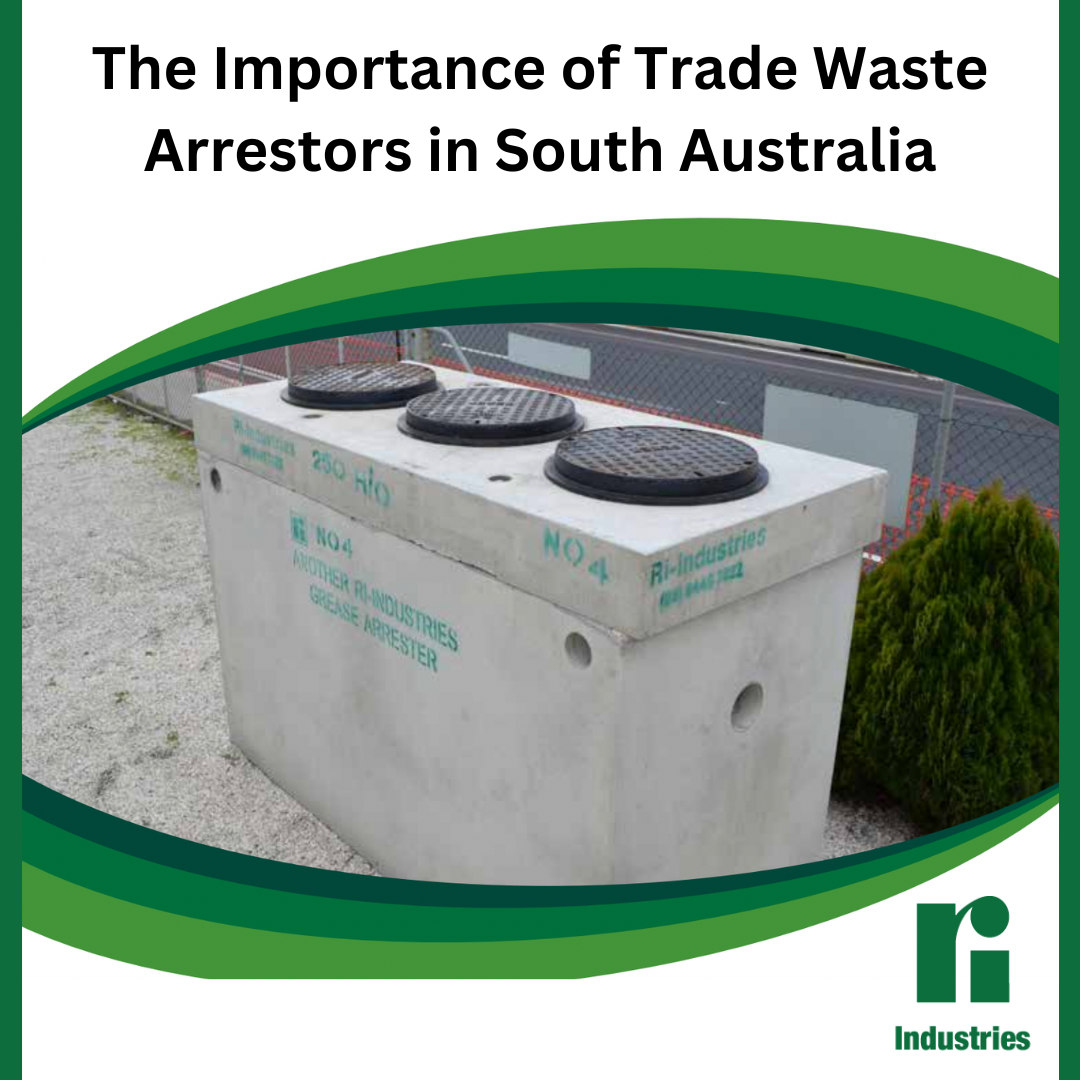
image of trade waste arrestors

Trade waste arrestors are essential for businesses in South Australia that generate trade waste. What is trade waste? It’s liquid wastewater from a commercial or industrial entity that enters the sewer system. Some trade waste must be pre-treated before entering the sewer system. In those cases, trade waste arrestors are used to stop harmful trade waste entering the drainage system where it may affect people or the environment. The arrestors capture the waste and allow it to settle and separate. The treated wastewater can then safely enter the sewer system while the harmful waste can be disposed of.

A number of different trade waste arrestors are available including silt, grease and detention tanks. The type of trade waste arrestor that is required for a business will depend on the type and volume of trade waste that it generates. If your business requires one, our experts can help determine which type is correct for your business.

Let’s look at some of the benefits of using trade waste arrestors in South Australia:

  • Protects sewerage systems from damage: Trade waste arrestors trap pollutants that can damage sewerage systems, such as oil, grease, and suspended solids. This helps to prevent blockages and overflows, which can cause flooding and environmental damage.
  • Protects the environment: Trade waste arrestors trap pollutants that can pollute waterways and the environment, such as oil, grease, and chemicals. This helps to keep our waterways clean and safe for people and wildlife.
  • Prevents fines: Businesses that discharge trade waste without a trade waste arrestor can be fined by SA Water. By installing a trade waste arrestor, you can help to protect yourself from fines and financial penalties.
  • Improves public health: Trade waste arrestors help to reduce the risk of disease by preventing the spread of pollutants, such as bacteria and viruses. This helps to protect public health and safety.

Learn about the benefits of a Ri-Industries trade waste arrestor along with some information about the installation and maintenance by reading Trade Waste Arrestors by Ri-Industries – Benefits, Installation, and Maintenance

If you are a business in South Australia that generates trade waste, you should have a trade waste arrestor installed. This is an important investment that will help to protect your sewerage system, the environment, and public health. Learn about the Ri-Industries Trade Waste Arrestor on our website and call to 8444 8100 to speak with one of our experts.

Environmental Benefits of Concrete Septic Tanks

by Ri Industries

The environmental benefits of concrete septic tanks are an important factor when deciding on
the type of septic tank to install for your home or business. We understand the importance of
caring for our environment, after all, we live here too. So, let’s take a moment to look at the
environmental benefits of the concrete septic tanks designed and built by Ri-Industries.
Concrete septic tanks offer several environmental benefits in South Australia. Here are some
key advantages:

1. Durability and Longevity: Concrete septic tanks have a long lifespan, typically lasting for
several decades. This durability reduces the need for frequent replacements, minimising
waste and the environmental impact associated with manufacturing and installing new
tanks.

2. Resistance to Groundwater Contamination: Concrete septic tanks are designed to be
watertight, preventing the leakage of effluent into the surrounding groundwater. This
feature helps protect the quality of groundwater, which is essential for drinking water
supplies and the health of ecosystems.

3. Efficient Treatment of Wastewater: Concrete septic tanks provide an effective means of
treating wastewater from households. They separate solid waste from liquids and allow
the natural decomposition of organic matter. The treated effluent, which is typically
higher in quality, can then be released into the soil through a drainage field or leach
drain system, where further treatment occurs.

4. Nutrient Recycling: The effluent produced in concrete septic tanks contains valuable
nutrients, such as nitrogen and phosphorus. When properly treated and managed, this
nutrient-rich effluent can be beneficial for fertilising plants and enhancing soil fertility,
reducing the need for synthetic fertilisers.

5. Reduced Energy Consumption: Concrete septic tanks operate passively, without the
need for electricity or mechanical components. They rely on natural processes, such as
gravity and bacterial activity, to function effectively. This feature reduces energy
consumption and the associated greenhouse gas emissions.

6. Minimised Chemical Usage: Compared to other wastewater treatment systems, concrete
septic tanks typically require fewer chemicals for operation and maintenance. This
aspect reduces the potential for chemical contamination in the environment and lowers
the reliance on potentially harmful substances.

It’s important to note that proper design, installation, and regular maintenance are crucial for
maximising the environmental benefits of concrete septic tanks. Regular inspections, pump-
outs, and adherence to local regulations and guidelines are necessary to ensure their optimal
performance and minimise any potential negative impacts on the environment.

We welcome the opportunity to speak with you about our products. You can learn more by
going to our website or by calling 08 8444 8100.

Sustainable Home Designs Benefit from Including Concrete Rainwater Tanks

by Ri Industries

Underground concrete rainwater tanks can play a vital role in sustainable home design and
construction practices. Here are some ways in which they can be seamlessly incorporated:

1. Integrated Water Management: Designing a sustainable home involves efficient water
management. Concrete rainwater tanks can be integrated into the overall water
management system, collecting and storing rainwater for various uses such as toilet
flushing, laundry, garden irrigation, and even potable water with proper filtration. By
incorporating rainwater tanks, homeowners can reduce their reliance on mains water
supply, conserve water resources, and minimise the environmental impact of water
consumption.

2. Green Roofs and Walls: Concrete rainwater tanks can be integrated into green roof or
green wall systems. These systems involve vegetation planted on roofs or walls, which
can help insulate the building, reduce stormwater runoff, and improve air quality. The
rainwater collected in the tanks can be used for irrigation, ensuring the plants receive an
adequate water supply.

3. Sustainable Landscaping: Concrete rainwater tanks can support sustainable
landscaping practices. The collected rainwater can be used for watering plants, lawns,
and gardens, reducing the reliance on potable water and conserving water resources.
Additionally, the tanks can be designed to incorporate overflow systems that direct
excess water to permeable surfaces or bioswales, minimizing runoff and replenishing
groundwater.

4. Durability and Longevity: Concrete rainwater tanks are known for their durability and
longevity. By incorporating these underground tanks into the initial construction of a
sustainable home, homeowners can ensure long-term water storage and reduce the
need for replacements or repairs. This reduces waste and supports a more sustainable
approach to building materials.

5. Education and Awareness: Incorporating concrete rainwater tanks into sustainable home
design provides an opportunity to educate homeowners and raise awareness about the
importance of water conservation and sustainable practices. Homeowners can learn

about the benefits of rainwater harvesting, the water cycle, and how their actions can
contribute to environmental sustainability.

By considering the aspects above, homeowners can enhance the sustainability of their homes
while reducing their environmental footprint.

As a manufacturer of pre-cast concrete products, Ri-Industries can provide you with below
ground concrete rainwater tanks. Designed and manufactured in Adelaide to the highest
standards, our underground rainwater tanks are superior quality, with a range of sizes available.
Our team has the perfect rainwater tank for you. Call 08 8444 8100 to learn more. We look
forward to hearing from you!

How Concrete Septic Tanks Play a Role in Sustainable Living and Reducing Waste

by Ri Industries

Concrete septic tanks can play a significant role in sustainable living and
reducing waste. We’ve previously written a number of articles about water
conservation. You can find those articles on our website.

Today we’d like to talk about a few ways in which concrete septic tanks can
contribute to a more sustainable and environmentally-friendly way of living:

1. Waste management: Concrete septic tanks are designed to treat and
store wastewater from households, allowing for safe and effective
disposal of waste. This helps to reduce the amount of waste that
ends up in landfills and minimizes the risk of pollution and
contamination to the environment.

2. Water conservation: A properly functioning concrete septic tank can
help to conserve water by treating and reusing wastewater. This can
be particularly useful in areas where water is scarce, as it allows for a
sustainable supply of water for household and agricultural use.

3. Energy efficiency: Concrete septic tanks can be designed and
installed in a way that maximizes energy efficiency. For example,
some designs use gravity to move wastewater through the system,
which reduces the need for energy-intensive pumps.

4. Durability: Concrete septic tanks are known for their durability and
long lifespan. This means that they can last for many years with
proper maintenance, reducing the need for frequent replacements
and waste.

As you can see, concrete septic tanks can play a key role in reducing waste
and promoting sustainability in households and communities. By
effectively treating and managing wastewater, conserving water,
maximizing energy efficiency, and being durable, concrete septic tanks can
help to create a more sustainable future.

Would you like to learn more about the Ri-Industries septic tank? You may
click this link or call us at 08 8444 8100.

Rainwater Collection Tanks, What are the Benefits?

by Ri Industries

Rainwater collection tanks are a popular option for households and businesses in South
Australia, especially in areas where water is scarce or expensive. The state government
encourages the use of rainwater tanks through various initiatives, such as rebates and
education programs.

The benefits of using rainwater tanks in South Australia include:

1. Water conservation: South Australia is a water-scarce region, and rainwater tanks help
to conserve water by collecting and storing rainwater for later use.
2. Cost savings: Rainwater tanks can help reduce water bills, particularly in areas where
water is expensive.
3. Improved water quality: Rainwater is often of higher quality than mains water, as it is free
from the chemicals used to treat mains water.
4. Reduced strain on infrastructure: Rainwater tanks can help reduce demand on mains
water infrastructure, particularly during times of drought.

When using rainwater collection tanks in South Australia, it is important to ensure that the tanks
are properly installed and maintained. This includes regular cleaning of the tank and ensuring
that it is correctly plumbed into the household or business water supply.
It is also important to check with local councils and water authorities for any regulations or
requirements related to the installation and use of rainwater tanks, as these can vary depending
on the area.

Ri-Industries offers concrete rainwater tanks that are built to last. Designed and manufactured in
Adelaide to the highest standards, our underground rainwater tanks are superior quality, with a
range sizes available.

Concrete rainwater tanks offer a number of advantages:

● The water stays cooler.
● No algae develops.
● The water has no after-taste.
● They are vandal-proof and fire-proof.
● Being underground means they are out of sight and don’t take up much of your valuable
real estate.
● Concrete is stronger and more durable.

Coupled with our manufacturer’s warranty, you can be sure that rainwater tanks from Ri-
Industries will last the distance.

Call us on 08 8444 8100 to learn more or request a quote. Our team are more than happy to
answer any questions you may have.


Septic Tank Inspections_ Why They’re Necessary and How Often You Should Get One

by Ri Industries

Image of septic tank truck and text saying Septic Tank Inspections: Why They're Necessary and How Often You Should Get One

Septic tank inspections are an essential part of maintaining your septic system. They help to identify any potential issues early on, before they become major problems that require costly repairs or replacements.

There are a few reasons why septic tank inspections are necessary:

  • To ensure proper functioning: Septic tanks need to be working correctly to prevent sewage backups or overflows, which can be hazardous to your health and the environment.
  • To detect problems early: During an inspection, a professional can identify any issues with your septic system, such as leaks or blockages, and take corrective action before they cause damage.
  • To comply with local regulations: In many areas, regular septic tank inspections are required by law to ensure public health and safety.

So, how often should you get your septic tank inspected? The frequency of inspections will depend on several factors, including the size of your tank, the number of people in your household, and your water usage habits.

As a general rule, it’s recommended that you have your septic tank inspected every three to five years. However, if you have a large household or heavy water usage, you may need to have it inspected more frequently.

It’s also important to note that some signs may indicate the need for an inspection sooner. For example, if you notice slow drains, foul odours, or pooling water near your tank, you should have your septic system inspected as soon as possible.

Our website has a number of blogs containing helpful information about septic tanks. If you still have questions, we’ll be happy to answer.  Please call 08 8444 8100.


Concrete Rainwater Tanks – What are the Benefits?

by Ri Industries

Get your rainwater tank in time for the ‘rainy season’ in South Australia. We get most of our
rainfall during the winter months of June, July and August, so now is a great time to get
prepared. Let’s look at some of the benefits of using a Ri-Industries concrete rainwater tank.
Rainwater harvesting is a technique used for collecting, storing and using rainwater for
landscape irrigation and other uses. It’s popular in South Australia due to its numerous benefits
such as:

● Reduces water bills
● Provides an alternative water supply during water restrictions
● Helps maintain a green and healthy garden
● Depending upon the tank size and climate, rainwater harvesting can reduce mains water
use by 100%
● Decreases storm water runoff, thereby helping to reduce local flooding.
● Rainwater causes less erosion to household appliances due to their low salinity content
● Rainwater is softer than mains water which may mean you use less soap, detergent, and
shampoo.

What are the benefits of our concrete rainwater tank? Concrete rainwater tanks offer a number
of advantages:

● The water stays cooler.
● No algae develops.
● The water has no after-taste.
● They are vandal-proof and fire-proof.
● Being underground means they are out of sight and don’t take up much of your valuable
real estate.
● Concrete is stronger and more durable.

How much water can be saved using our concrete rainwater tanks? A family of four with a
100m² roof catchment area and a 1000L tank can capture enough rainwater in one year to:

● Flush a toilet 2X/day per person
● Fill a 150L tub to provide a bath for one person per week

● Run a sprinkler system for one hour 5X/week
● Use dishwasher every day
● Give a 5 minute shower to each person 2X/week

Good for the environment + saves money = a great investment! Call us at 08 8444 8100 to
speak with one of our experts and learn about installing a concrete rainwater collection tank at your home.

Lawn Care and Gardening Tips for Summer in Adelaide

by Ri Industries

Now it’s summer, we thought we would round up some lawn care and gardening tips to share with you. The summer growing season is, generally speaking, from December to February. In some Australian climates, it may begin as early as November or end as late as March, so checking your local climate is a great place to start. 

Why does ri-industries.com.au write articles about lawn care and gardening? Because we want to help everywhere we can! Our tips can help you reduce water bills and properly care for your septic system. 

Let’s talk about conserving water and reducing bills. 

  • A simple step to take is to water early in the morning or overnight. Watering while the temperature is relatively cool allows the lawn and garden the chance to fully absorb the water. Watering late in the day can produce humidity overnight which can lead to the development of fungus.
  • Water the garden only when it needs to be watered. How will you know? Stick your finger about 4 cm into the soil, and if the soil is not moist, it’s time to water.
  • Be thorough when watering the garden. Flower beds can do just fine when watered just once or twice per week as long as it’s a good, thorough soak. 
  • Did you know that you can reuse waste water to water the lawn via sub surface irrigation and garden? The surface irrigation disposal area must be dedicated to the sole use of effluent disposal. The area must be landscaped, preferably with salt tolerant shrubs and trees and should be designed to discourage pedestrian and vehicle access. The Ri-Treat Waste Water System works to clean and reuse your waste water from the toilet, kitchen, and laundry to irrigate your garden. This system is a cost-efficient and environmentally friendly way to keep your garden looking green and healthy.
  • Collect rainwater and use it to water the lawn and garden. Our article How to Water Your Garden With Water Collected in a Rainwater Tank talks about the benefits of using a rainwater tank and how to use it.

Now let’s talk about lawn and garden tips to help protect the septic system.

  • Be mindful of the septic tank soakaway. A septic tank soakaway is a series of underground, perforated pipes that allow septic tank effluent to soakaway over a large area. A lawn is the best cover for the soakaway. It will help prevent soil erosion while adding beauty to the landscape. When planting, do not dig too deep and be sure to wear gloves to protect against bacteria that may be in the soil.
  • Know what/what not to plant around a septic tank. First, do not plant anything with deep roots or anything that will be super thirsty. Second, don’t ever plant fruits or vegetables over the septic tank! Third, it’s recommended to plant the right kind of vegetation over the septic tank such as perennials, annuals, and grass. Willow Myrtle trees, Swamp Oak trees, River Red Gum trees, Papyrus shrubs, and Oleander shrubs make particularly good choices to plant near the septic tank. Learn more in our articles Tips for Planting Around a Septic Tank and Tips for Planting Over Septic Drain Fields.

As you can see, we care about providing quality products which benefit the environment as well as you. Our experts will be happy to speak with you and the products that can best suit your needs. Please call us at 08 8444 8100.


Delivery of Waste Water Treatment Systems and Septic Tanks

by Ri Industries

Truck delivering Ri-Industries concrete septic tank

Delivery of waste water treatment systems, water tanks and septic tanks requires planning and organising a number of moving pieces. Let’s take a look at how delivery works at Ri-industries.com.au.

Before we talk about the ‘normal’ process, it’s important to mention that rainy and wet conditions can sometimes mean that deliveries are delayed or rescheduled.  We will always do our best to deliver our tanks as scheduled but if your property experiences a lot of rain before delivery, this can make access difficult due to the ground become slippy or even boggy for our trucks. We confirm every delivery the day before so if your site is particularly wet please let us know, so we can work out the best course of action with you, to avoid our trucks getting bogged on site.

We take our involvement in the delivery process very seriously and ensure we comply with the compliance and enforcement (C&E) legislation in relation to potential road safety breaches. We exercise due care and take reasonable steps to prevent breaches of road safety law, and we expect our business partners to do the same. This includes ‘third party transport’ collection of goods from our premises. All transport providers collecting goods from our premises will be required to prove compliance or provide details of the relevant person within the business that we are able to contact for compliance details. This ensures all parties within the ‘Chain of Responsibility’ are protected via the reasonable steps defence measure.

Ri-Industries has a fleet of vehicles available for delivery. This includes crane trucks that are modern, clean, and purpose built. Our drivers are professionals who will do their best to help you when delivering the product on-site. We offer a FREE on-site visit inspection regarding delivery.

We will need to assess the best way to unload your tank, taking factors into account such as:

  • We will need to reverse up to the hole therefore easy access is very important
  • A clear, level site is required to unload the tank in your excavated area
  • 4.7 metres is needed for the truck to pass under trees and overhead power lines
  • A minimum height clearance of 8 metres is required when unloading
  • 4 metres clearance is required between gate posts.
  • Our trucks are 10 metres long and 2.5 metres wide. 

We use a ‘Swiftlift’ lifting system for our products, which is approved for use by the regulatory authorities in every state of Australia and New Zealand. It’s a safe and rapid method of lifting and handling precast concrete elements. A specially designed ‘lifting eye’ is also used. It’s designed so that, when properly connected to the head of the embedded anchor, it cannot release whilst the system is under load. The ‘lifting eye’ may be purchased from our office. 

Our staff are here to help ensure the delivery process goes smoothly. Please call us at 08 8444 8100 with any questions. 


Rainwater Harvesting Will Help Conserve Water and Lower Costs

by Ri Industries

Rainwater harvesting is an excellent way to conserve water and lower expenses. The rainfall we’ve been seeing in South Australia makes this a great time to learn about rainwater harvesting and see if it’s something you’d like to do. 

First, let’s answer the question, ‘What is rainwater harvesting?’. Simply put, it’s collecting and storing rain for later use. So now, let’s take a look at how the water can be used and how it is collected. 

Harvested rainwater provides clean water where water is scarce or polluted. It can be used to flush toilets, do laundry, water the garden, wash cars, and more. However, if you want to be able to drink the water, the system must be designed, operated, and maintained to ensure the water quality is suitable. 

It’s often thought that rainwater harvesting is only done in rural areas. In fact, many urban households harvest rainwater to significantly lower mains water usage. According to www.sa.gov.au, “South Australian building rules require that new dwellings and some extensions or alterations, have an additional water supply to supplement mains water. The most common way to meet the additional water supply requirement is to install plumbed minimum-sized rainwater tanks.”

Is harvesting rainwater more costly than only using mains water? No! Once the tank is installed and your water use is supplemented by the harvested rainwater, your water bills should be lower. After all, rainwater is free!

Harvested rainwater is collected from various hard surfaces such as rooftops and/or other man made above ground hard surfaces. The water is stored in a tank. The below diagram (credit: treehugger.com) shows how rainwater harvesting works.

Ri-Industries manufactures underground concrete rainwater tanks. Concrete rainwater tanks offer a number of advantages:

  • The water stays cooler.
  • No algae develops.
  • The water has no after-taste.
  • They are vandal-proof and fire-proof.
  • Being underground means they are out of sight and don’t take up much of your valuable real estate.
  • Concrete is stronger and more durable.

Our rainwater tanks are built to stand the test of time. They’re made from high frequency vibrated reinforced concrete using the highest quality of materials. Steel mesh is cast into the rainwater tanks and lids, and all fittings are made from brass – to give additional peace of mind. We also have full engineering approval for below ground tanks. This means you can rest easy knowing that a Ri-Industries rainwater tank will serve you well, wherever it is installed. We can also custom make inlets and outlets to suit your specific requirements. 

Are you ready to conserve water and save money? Call us at 08 8444 8100 and let know how we can help you!